Global Player
May 2025
Optimising a core listening experience for accessibility, editorial control, and long-term scale
Optimising a core listening experience for accessibility, editorial control, and long-term scale

Live Radio is one of the most frequently used features in the Global Player app and a key driver of daily engagement. It connects listeners directly to stations in real time and plays a central role in how audiences experience our brands.
Despite its importance, the Live Radio screen had remained largely unchanged for years. As the business expanded its station offering and design system maturity increased, this surface became increasingly difficult to evolve technically, editorially, and from an accessibility perspective.
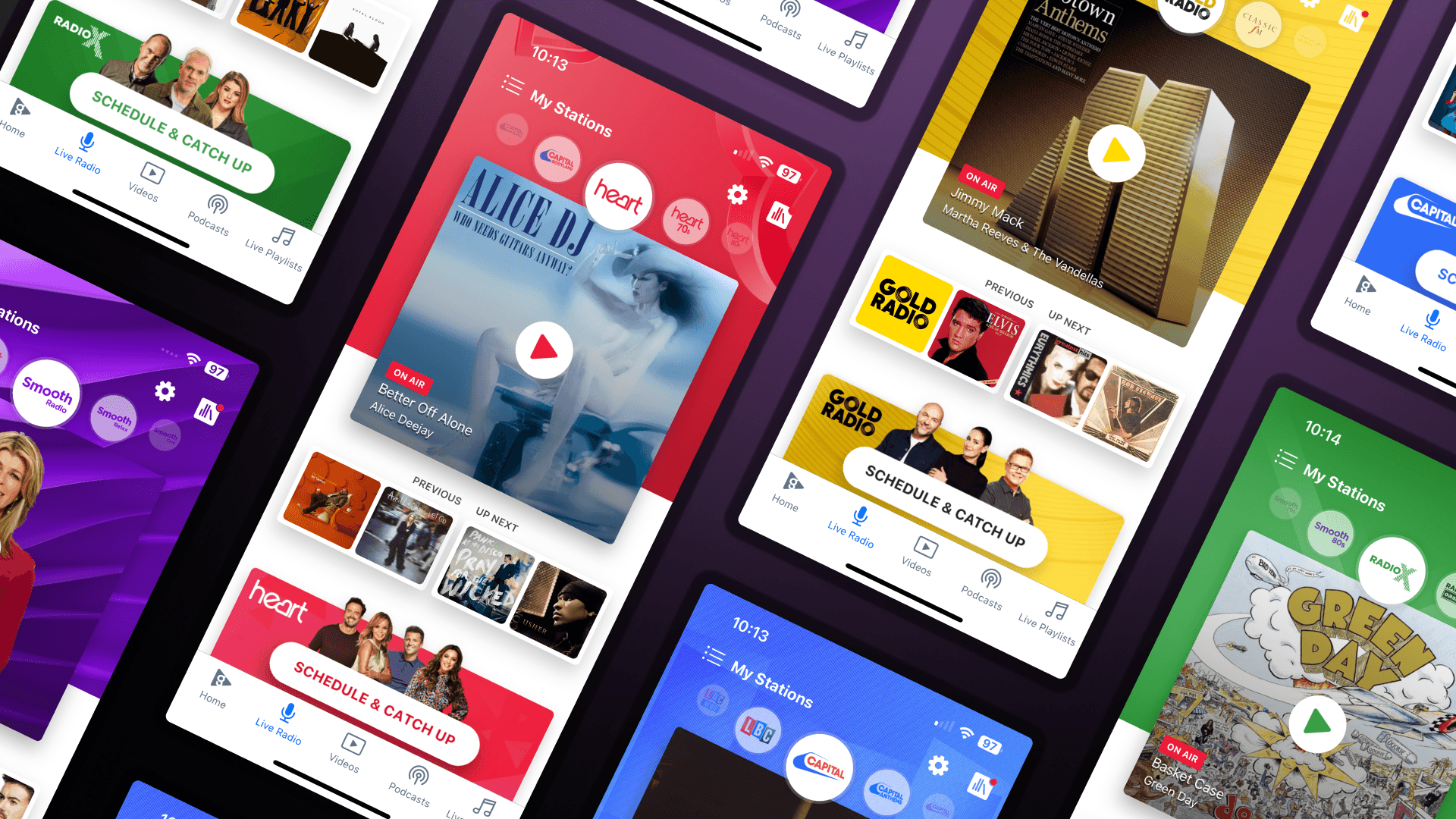
I led the redesign of Live Radio to modernise the experience without losing the familiarity users trusted.
Role
Lead Product Designer
Team
1x Product Manager
6x Engineers
Impact
Faster financial decisions for small businesses
Helped product team validate product-market fit
Actionable dashboard improved client retention
Fewer support tickets after launch
Problem area
Small visual changes, big impact
Small visual changes, big impact
The Live Radio tab was the last remaining core legacy surface in the app.
While users valued its simplicity, it presented several growing risks:
Accessibility failures
Brand colour combinations regularly failed contrast requirements, tap targets were inconsistent, and assistive technology support was incomplete.
Limited editorial control
Content updates were hard-coded and required developer involvement, slowing down teams and preventing real-time responsiveness.
Poor scalability
The layout didn’t adapt well across screen sizes, themes, or an expanding portfolio of stations, making it costly to maintain and fragile to change.
The challenge was not to “redesign for the sake of it”, but to evolve a well-loved experience into something that could scale with the product and the business.
Product before redesign
Opportunity 1
Transform rigid, developer-owned layouts into flexible editorial tools, enabling real-time content updates and faster response to live moments.
Opportunity 2
Evolve a familiar Live Radio experience into an accessible, scalable system without disrupting user trust or listening habits.
Design goals
Design goals
What I aimed to achieve
What I aimed to achieve
Preserve familiarity
Maintain the core interaction patterns listeners already understood and trusted.
Meet accessibility standards
Bring the experience in line with WCAG guidelines across contrast, navigation, and interaction.
Design for scale
Create a modular system that could support 35+ stations, light and dark themes, and future product changes.
Enable editorial autonomy
Give editorial teams real-time control over content on station pages without relying on product owners’ manual JSON update.
Preserve familiarity
Maintain the core interaction patterns listeners already understood and trusted.
Meet accessibility standards
Bring the experience in line with WCAG guidelines across contrast, navigation, and interaction.
Design for scale
Create a modular system that could support 35+ stations, light and dark themes, and future product changes.
Enable editorial autonomy
Give editorial teams real-time control over content on station pages without relying on manual JSON updates.
Design decision 01
Reframing the problem
Reframing the problem
Although initially scoped as a UI update, it became clear the real issues sat beneath the surface. The legacy Live Radio screen was tightly coupled to the codebase, difficult to maintain, and misaligned with evolving editorial workflows.
By reframing the problem around systems, scalability, and ownership, we shifted focus from isolated screen improvements to long-term product health, aligning stakeholders on my design goals.
Rather than focusing on individual screens, I reframed the focus around:
Component reuse instead of bespoke layouts
Design system alignment instead of one-off solutions
Editorial workflows, not just visual output
This helped align stakeholders around long-term value rather than short-term polish.

Live Listening Engagement
Tracks how often and how long listeners engage with live radio across stations.
Accessibility Compliance
Monitors improvements across contrast, tap targets, and assistive technology support.
Editorial Efficiency
Measures time and effort required for teams to update live content without developer support.
Performance & Load Speed
Tracks screen load times and interaction responsiveness across devices.
Editorial Efficiency
Measures time and effort required for teams to update live content without developer support.
Performance & Load Speed
Tracks screen load times and interaction responsiveness across devices.
Design decision 02
Leverage the Global Player design system to create consistency across stations without compromising brand identity
Leverage the Global Player design system to create consistency across stations without compromising brand identity
Live Radio needed to support 35+ stations, each with distinct branding, without resorting to bespoke layouts. By grounding the redesign in shared components, tokens, and layout principles, we achieved consistency across the app while still allowing station personalities to shine through.
This reduced duplication, simplified maintenance, and ensured new stations could scale without additional design or engineering overhead.

Design decision 03
Modernise the Live Radio experience to meet accessibility and performance standards without disrupting user trust
Modernise the Live Radio experience to meet accessibility and performance standards without disrupting user trust
The previous Live Radio experience limited editorial autonomy and relied heavily on developer support. By designing modular, configurable components, editorial teams gained the ability to update content and visuals in real time — without sacrificing performance or stability.
Whilst I also proposed changes to the station navigation, the previous work I had done on My Stations has since solved the user pain point of navigating across a long list of stations. This allowed us to keep the original and well-loved infinite station selector.
Version 01: What I first pitched to stakeholders

Learning 01
Preserving familiarity can be more valuable than introducing novelty in high-trust experiences.
Learning 02
Design systems are most effective when paired with clear ownership and editorial workflows.
Retrospective
Designing for trust, scale, and editorial ownership.
Designing for trust, scale, and editorial ownership.
The increased flexibility of the Live Radio experience has unlocked new ways for teams across Global Player to collaborate, experiment, and respond to cultural moments in real time.
One of the clearest outcomes was the launch of WSQK – The Squawk, our most successful pop-up station to date. Delivered in collaboration with Netflix to promote the final season of Stranger Things, it demonstrated how quickly editorial, product, and commercial teams could move using the new Live Radio foundations.
This same system has supported additional pop-up stations — including pop-up stations for Taylor Swift’s “The Eras Tour” and one for the Oasis reunion, all without requiring bespoke UI design nor much engineering effort.
What began as a Live Radio refresh ultimately became an enabler for more iconic partnerships, stronger experimentation, and shared ownership across teams.
The increased flexibility of the Live Radio experience has unlocked new ways for teams across Global Player to collaborate, experiment, and respond to cultural moments in real time.
One of the clearest outcomes was the launch of WSQK – The Squawk, our most successful pop-up station to date. Delivered in collaboration with Netflix to promote the final season of Stranger Things, it demonstrated how quickly editorial, product, and commercial teams could move using the new Live Radio foundations.
This same system has supported additional pop-up stations — including pop-up stations for Taylor Swift’s “The Eras Tour” and one for the Oasis reunion, all without requiring bespoke UI design nor much engineering effort.
What began as a Live Radio refresh ultimately became an enabler for more iconic partnerships, stronger experimentation, and shared ownership across teams.

Impact
Improved accessibility outcomes
Internal audits showed clear improvements in contrast, navigation, and interaction quality.
30% faster load times
Achieved through leaner architecture, shared components, and design system tokens.
+100% editorial efficiency
Teams can now update content in real time without developer tickets, scaled across 35+ stations.

Thanks for stopping by. This portfolio site was built with a dash of chaos, and a whole lot of care. Everything here reflects how I approach design: inclusivity, intuitiveness, but make it cute.
For collabs, contact: jess.seguradesign@gmail.com.
© Jess Segura 2026. All rights reserved.
Made with Framer
Thanks for stopping by. This portfolio site was built with a dash of chaos, and a whole lot of care. Everything here reflects how I approach design: inclusivity, intuitiveness, but make it cute.
For collabs, contact: jess.seguradesign@gmail.com.
© Jess Segura 2026. All rights reserved.
Made with Framer
Thanks for stopping by. This portfolio site was built with a dash of chaos, and a whole lot of care. Everything here reflects how I approach design: inclusivity, intuitiveness, but make it cute.
For collabs, contact: jess.seguradesign@gmail.com.
© Jess Segura 2026. All rights reserved.
Made with Framer
Global Player
May 2025
Optimising a core listening experience for accessibility, editorial control, and long-term scale
Live Radio is one of the most frequently used features in the Global Player app and a key driver of daily engagement. It connects listeners directly to stations in real time and plays a central role in how audiences experience our brands.
Despite its importance, the Live Radio screen had remained largely unchanged for years. As the business expanded its station offering and design system maturity increased, this surface became increasingly difficult to evolve technically, editorially, and from an accessibility perspective.
I led the redesign of Live Radio to modernise the experience without losing the familiarity users trusted.
Role
Lead Product Designer
Team
1x Product Manager
6x Engineers
Impact
Faster financial decisions for small businesses
Helped product team validate product-market fit
Actionable dashboard improved client retention
Fewer support tickets after launch
Problem area
Small visual changes, big impact
The Live Radio tab was the last remaining core legacy surface in the app.
While users valued its simplicity, it presented several growing risks:
Accessibility failures
Brand colour combinations regularly failed contrast requirements, tap targets were inconsistent, and assistive technology support was incomplete.
Limited editorial control
Content updates were hard-coded and required developer involvement, slowing down teams and preventing real-time responsiveness.
Poor scalability
The layout didn’t adapt well across screen sizes, themes, or an expanding portfolio of stations, making it costly to maintain and fragile to change.
The challenge was not to “redesign for the sake of it”, but to evolve a well-loved experience into something that could scale with the product and the business.
Product before redesign
Opportunity 1
Transform rigid, developer-owned layouts into flexible editorial tools, enabling real-time content updates and faster response to live moments.
Opportunity 2
Evolve a familiar Live Radio experience into an accessible, scalable system without disrupting user trust or listening habits.
Design goals
What I aimed to achieve
Preserve familiarity
Maintain the core interaction patterns listeners already understood and trusted.
Meet accessibility standards
Bring the experience in line with WCAG guidelines across contrast, navigation, and interaction.
Design for scale
Create a modular system that could support 35+ stations, light and dark themes, and future product changes.
Enable editorial autonomy
Give editorial teams real-time control over content on station pages without relying on manual JSON updates.
Design decision 01
Reframing the problem
Although initially scoped as a UI update, it became clear the real issues sat beneath the surface. The legacy Live Radio screen was tightly coupled to the codebase, difficult to maintain, and misaligned with evolving editorial workflows.
By reframing the problem around systems, scalability, and ownership, we shifted focus from isolated screen improvements to long-term product health, aligning stakeholders on my design goals.
Rather than focusing on individual screens, I reframed the focus around:
Component reuse instead of bespoke layouts
Design system alignment instead of one-off solutions
Editorial workflows, not just visual output
This helped align stakeholders around long-term value rather than short-term polish.
Live Listening Engagement
Tracks how often and how long listeners engage with live radio across stations.
Accessibility Compliance
Monitors improvements across contrast, tap targets, and assistive technology support.
Editorial Efficiency
Measures time and effort required for teams to update live content without developer support.
Performance & Load Speed
Tracks screen load times and interaction responsiveness across devices.
Design decision 02
Leverage the Global Player design system to create consistency across stations without compromising brand identity
Live Radio needed to support 35+ stations, each with distinct branding, without resorting to bespoke layouts. By grounding the redesign in shared components, tokens, and layout principles, we achieved consistency across the app while still allowing station personalities to shine through.
This reduced duplication, simplified maintenance, and ensured new stations could scale without additional design or engineering overhead.
Design decision 03
Modernise the Live Radio experience to meet accessibility and performance standards without disrupting user trust
The previous Live Radio experience limited editorial autonomy and relied heavily on developer support. By designing modular, configurable components, editorial teams gained the ability to update content and visuals in real time — without sacrificing performance or stability.
Whilst I also proposed changes to the station navigation, the previous work I had done on My Stations has since solved the user pain point of navigating across a long list of stations. This allowed us to keep the original and well-loved infinite station selector.
Version 01: What I first pitched to stakeholders
Learning 01
Preserving familiarity can be more valuable than introducing novelty in high-trust experiences.
Learning 02
Design systems are most effective when paired with clear ownership and editorial workflows.
Retrospective
Designing for trust, scale, and editorial ownership.
The increased flexibility of the Live Radio experience has unlocked new ways for teams across Global Player to collaborate, experiment, and respond to cultural moments in real time.
One of the clearest outcomes was the launch of WSQK – The Squawk, our most successful pop-up station to date. Delivered in collaboration with Netflix to promote the final season of Stranger Things, it demonstrated how quickly editorial, product, and commercial teams could move using the new Live Radio foundations.
This same system has supported additional pop-up stations — including pop-up stations for Taylor Swift’s “The Eras Tour” and one for the Oasis reunion, all without requiring bespoke UI design nor much engineering effort.
What began as a Live Radio refresh ultimately became an enabler for more iconic partnerships, stronger experimentation, and shared ownership across teams.
Impact
Improved accessibility outcomes
Internal audits showed clear improvements in contrast, navigation, and interaction quality.
30% faster load times
Achieved through leaner architecture, shared components, and design system tokens.
+100% editorial efficiency
Teams can now update content in real time without developer tickets, scaled across 35+ stations.